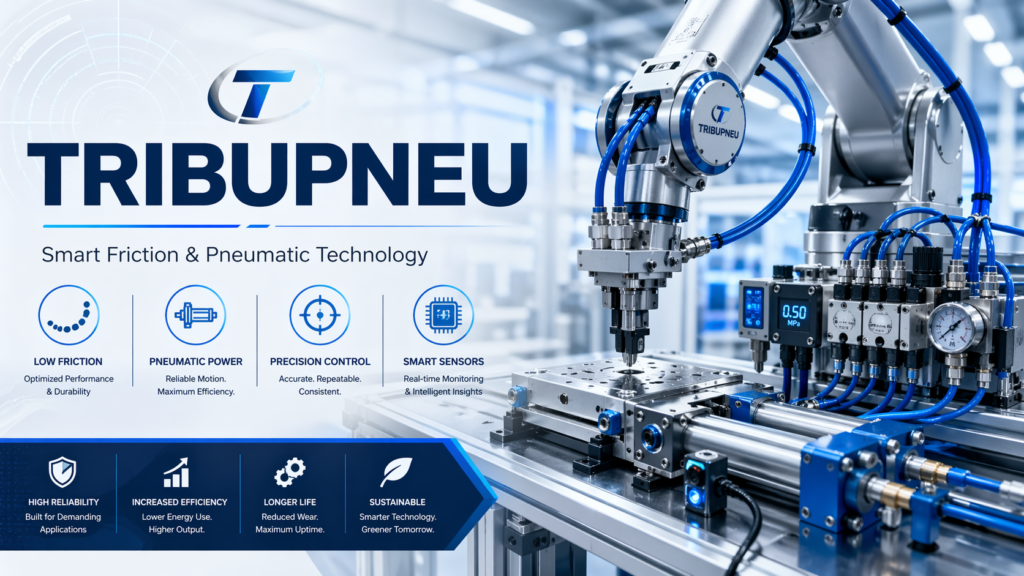
Have you ever wondered how machines move so smoothly and efficiently in modern factories? A big part of the secret lies in something called Tribupneu. It’s a term you might not have heard before, but it’s quietly transforming industrial automation. Let’s dive into it.
What Exactly is Tribupneu?
Tribupneu is a technology that blends tribology (the study of friction, wear, and lubrication) with pneumatic systems (air-powered mechanisms).
In simpler terms:
It’s about making machines move smoother, last longer, and use energy smarter by controlling friction and airflow at the same time.
- “Tribo” → friction and surface interaction
- “Pneu” → air or pressure systems
Together, they form a system that optimizes movement and reduces energy loss.
How Tribupneu Works
Tribupneu systems are clever. They don’t just move parts using air—they actively manage friction and airflow.
Key actions include:
- Air-driven motion: Pneumatic actuators, valves, or cylinders get the job done.
- Friction control: Special coatings and materials reduce wear and tear.
- Smart sensors: Track pressure, motion, and resistance in real time.
- Automatic adjustments: Airflow or lubrication changes to maintain efficiency.
This keeps machines running smoothly, even under heavy or irregular loads.
Main Components
Tribupneu relies on a few critical elements:
- Tribological surfaces: Reduce friction with advanced coatings.
- Pneumatic circuits: Air channels, valves, and regulators for precise motion.
- Sensors and feedback: Continuous monitoring of system performance.
- Smart control: Automatic adjustments based on real-time data.
Why Tribupneu Matters
Traditional pneumatic systems can waste energy and wear out fast. Tribupneu solves this with precision, longevity, and efficiency.
Benefits:
- Lower energy consumption
- Less component wear
- Longer machine lifespan
- More precise motion
- Reduced maintenance needs
It’s an upgrade that saves money and improves reliability.
How Tribupneu Helps Industries
Tribupneu isn’t just theory—it’s practical. Here’s where it shines:
1. Manufacturing
- Assembly lines stay consistent
- Packaging systems move accurately
- Conveyor belts work smoothly
2. Robotics
- Precise grip on delicate items
- Controlled repetitive movements
- Better overall automation
3. Industrial Automation
- Smart factories optimize airflow
- Machines adapt to varying workloads
- Energy and maintenance costs drop
4. Emerging Applications
- Tire and automotive systems
- Sustainable engineering solutions
- Advanced industrial machinery
Comparing Tribupneu to Traditional Systems
| Feature | Traditional Pneumatics | Tribupneu Systems |
|---|---|---|
| Friction | Minimal control | Advanced control |
| Efficiency | Moderate | High |
| Maintenance | Frequent | Reduced |
| Sensors | Rare | Integrated |
| Lifespan | Shorter | Longer |
Simply put, Tribupneu is the smarter, upgraded version.
How Machines Operate with Tribupneu
- Air pressure powers motion
- Air moves through regulated channels
- Surfaces are protected from friction
- Sensors continuously measure performance
- Automatic adjustments optimize motion
- Smooth, efficient operation continues
Even complex systems stay reliable and predictable.
Challenges & Considerations
- Initial cost can be higher
- Needs specialized materials and components
- Integration with older systems may require upgrades
But the long-term energy savings, efficiency, and reduced wear make it worthwhile.
The Future of Tribupneu
Tribupneu is evolving fast. Upcoming trends include:
- AI-integrated control for predictive maintenance
- Self-healing materials for extended lifespan
- Energy-efficient, environmentally conscious machinery
- Smarter, automated industrial setups
Industries moving toward automation, efficiency, and sustainability are adopting Tribupneu quickly.
FAQs
Is Tribupneu real?
Yes. It combines friction management and pneumatic systems to improve industrial machines.
Can it be added to old machinery?
Often, yes. Retrofits are possible depending on airflow and component compatibility.
Does it save energy?
Absolutely. Optimized friction and airflow reduce power consumption.
Which industries benefit most?
Manufacturing, robotics, industrial automation, and emerging tech applications.
Conclusion
Tribupneu may sound complicated, but it’s practical: smooth motion, energy savings, and longer-lasting machines.
In a world moving toward smarter automation, Tribupneu is the silent hero behind efficiency and reliability.