 By Admin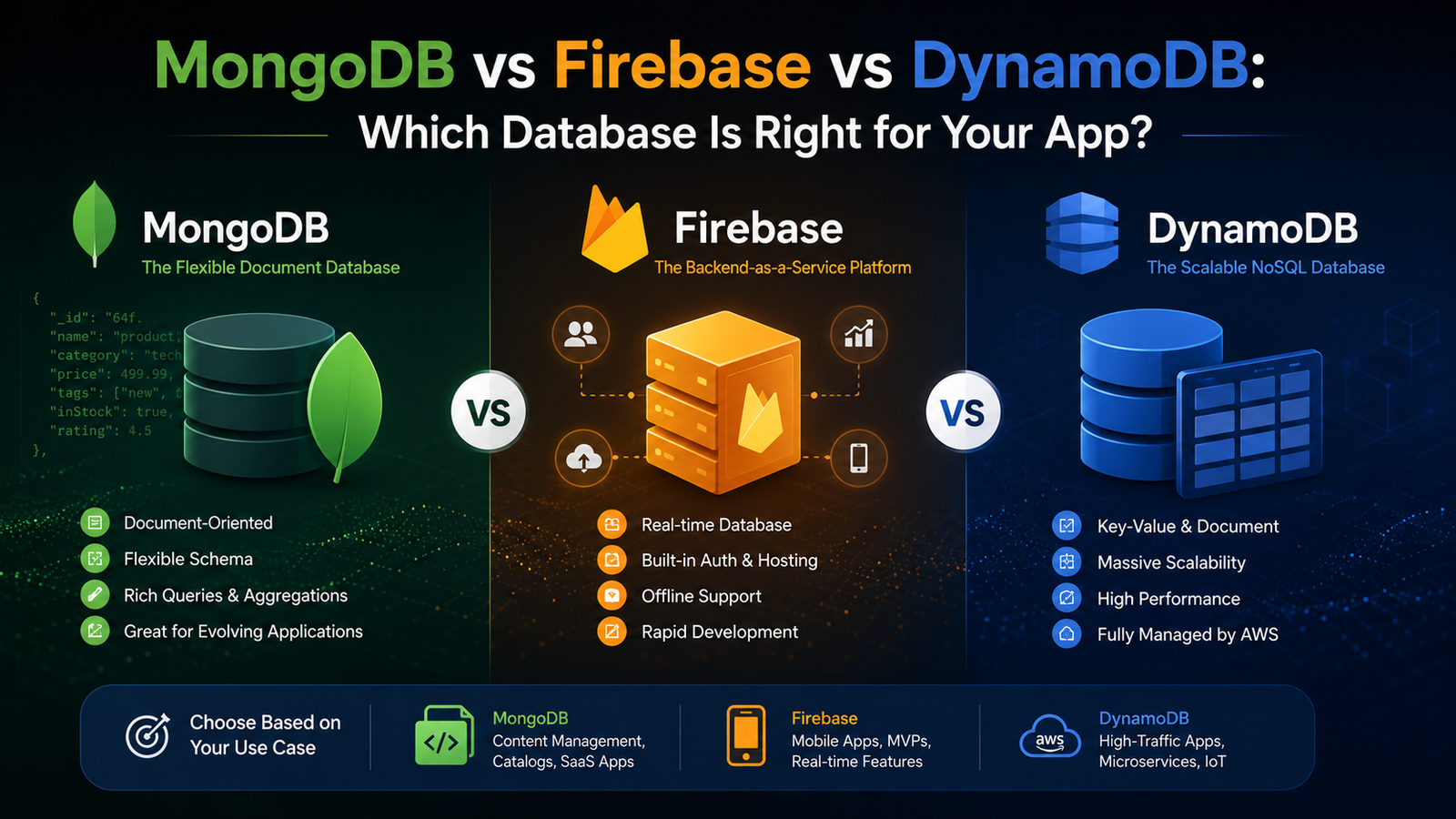
A successful app often starts with the right database choice. Since it affects performance, scalability, development speed, and cost, many businesses look at MongoDB vs Firebase vs DynamoDB before beginning a project.
MongoDB, Firebase, and DynamoDB are all widely used NoSQL databases, but they are built for different use cases. MongoDB is flexible, Firebase is useful for real-time features and faster builds, and DynamoDB is made for cloud-scale performance. The best option depends on your app goals, speed to launch, and backend requirements.
This guide explains the differences in a simple and practical way so businesses and teams can make the right decision.
MongoDB vs Firebase vs DynamoDB: Understanding the Basics
Before choosing one, it helps to understand what each platform is designed for.
- MongoDB is a document database that stores data in flexible JSON-like documents.
- Firebase is a backend platform from Google with database, authentication, hosting, and real-time support.
- DynamoDB is a fully managed NoSQL database from AWS built for speed and scale.
- All three are non-relational databases.
- All three can support modern web and mobile applications.
- Their biggest difference is in how they balance flexibility, simplicity, and scalability.
At a simple level, MongoDB gives more control, Firebase makes development faster, and DynamoDB is designed for high-volume cloud applications.
Why MongoDB Works Well for Flexible App Development
MongoDB is often chosen for custom applications because it is flexible and developer-friendly. It works well when the structure of data may change as the product grows.
MongoDB is a good fit for:
- content platforms
- e-commerce systems
- dashboards
- SaaS products
- apps with changing requirements
Its main strengths include:
- flexible schema design
- easier handling of unstructured data
- strong developer adoption
- broad framework support
- good scalability with the right setup
This is one reason businesses look for mongodb development services when building products that need customization and long-term adaptability.
Why Firebase Is Popular for Fast and Real-Time Applications
Firebase is often chosen by startups and fast-moving teams because it reduces backend complexity. Instead of building many services separately, teams can use Firebase to speed up development.
Firebase is especially useful for:
- chat apps
- collaboration tools
- MVPs
- mobile apps
- apps with live updates
Its biggest advantages are:
- real-time data syncing
- built-in authentication
- easy hosting options
- faster prototyping
- lower initial backend effort
Firebase works well for rapid development and early-stage products. As applications scale and become more complex, some teams may find its backend structure and querying flexibility less suitable.
When DynamoDB Is the Better Choice for Scale
DynamoDB stands out for performance and scalability in cloud environments. It is a good choice for businesses on AWS or applications that need to handle high traffic.
DynamoDB is commonly used for:
- enterprise apps
- gaming backends
- IoT systems
- high-traffic platforms
- cloud-native products
Its key strengths are:
- automatic scaling
- high availability
- low-latency performance
- reduced infrastructure management
- deep AWS integration
DynamoDB offers strong capabilities, but it often demands more careful data modeling. Compared with Firebase, it can feel less beginner-friendly, and compared with MongoDB, it may seem less flexible.
MongoDB vs Firebase vs DynamoDB: Side-by-Side Comparison
Here is a simple comparison to make the decision easier:
| Feature | MongoDB | Firebase | DynamoDB |
| Main strength | Flexibility | Fast development | Scalability |
| Best for | Custom apps | Real-time apps | High-scale cloud apps |
| Data model | Document | JSON/document | Key-value / document |
| Real-time support | Limited, extra setup | Strong | Indirect / event-driven |
| Infrastructure control | High | Lower | Managed by AWS |
| Ideal users | Custom product teams | Startups, mobile teams | AWS-based businesses |
This comparison helps show why it is not really about which one is best overall. It is about which one matches the app’s actual needs.
Which Database Is Better for Startups and Growing Products?
For startups, the choice usually depends on launch speed, flexibility, and future scale.
A simple way to think about it:
- choose Firebase for rapid MVP development
- choose MongoDB for flexible product evolution
- choose DynamoDB for cloud-heavy scale from the start
Startups should also think about:
- how quickly features may change
- whether real-time updates are important
- how much backend control is needed
- whether the product may scale fast
- what cloud ecosystem the team prefers
When businesses compare MongoDB, Firebase, and DynamoDB, they should look at both current goals and future growth, not just short-term convenience.
Cost, Maintenance, and Long-Term Planning
The right database is not only about features. Cost and maintenance also matter over time.
Important things to consider:
- Firebase can be affordable at first but may become costly with heavy usage.
- MongoDB gives deployment flexibility, which can help manage costs.
- DynamoDB pricing can be efficient, but only with good planning.
- Firebase reduces backend maintenance.
- DynamoDB removes much of the infrastructure burden.
- MongoDB may require more management depending on setup.
This is why database selection often becomes part of wider backend development services planning. It affects app architecture, long-term maintenance, and how easily the product can grow.
MongoDB vs Firebase vs DynamoDB: How to Make the Right Choice
There is no universal winner here. The best choice depends on your app type, technical goals, and expected scale.
Choose based on your priority:
- choose MongoDB if you want flexibility and customization
- choose Firebase if you want speed and real-time functionality
- choose DynamoDB if you want scale and AWS integration
Ask these questions before deciding:
- Will the app need real-time updates?
- Will the data structure change often?
- Is the team already using AWS or Google tools?
- Does the app need to support high traffic?
- Is faster launch more important than deeper backend control?
Choosing between MongoDB, Firebase, and DynamoDB is ultimately a practical decision, not only a technical comparison. The best database should fit your product now and still support it as your application expands.
Making the Right Database Choice for Long-Term Growth
Choosing between MongoDB, Firebase, and DynamoDB depends on what your app needs most. Some products need flexibility, some need real-time support, and others need cloud-scale performance. The right database should match your development goals, user needs, and long-term growth plans. With the right technical approach and expert guidance from Pattem Digital, businesses can choose a database solution that supports performance, scalability, and future-ready app development.