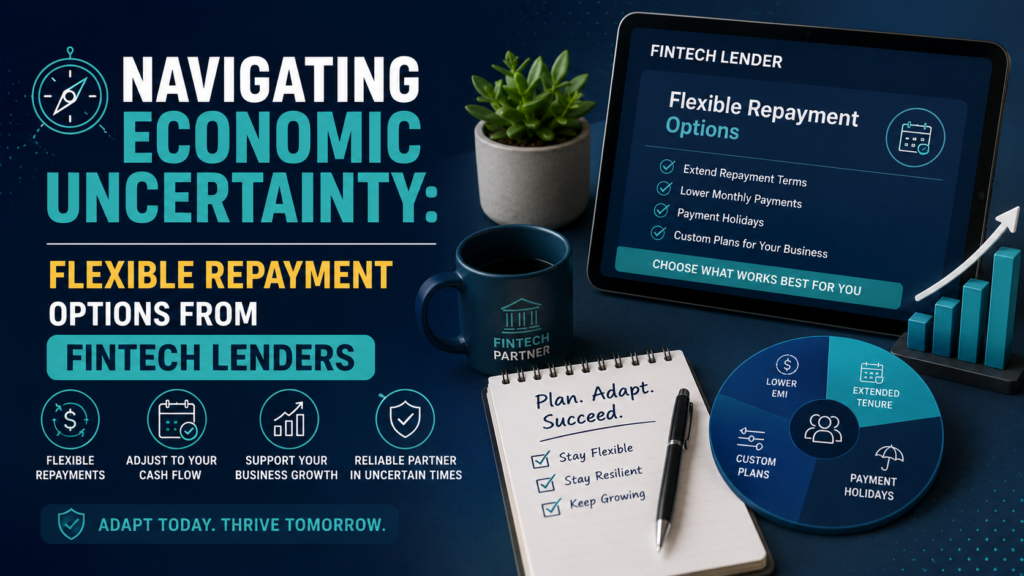
One of these challenges that characterizes the modern financial setting is economic uncertainty. Stiff interest rates, evolving demands in the markets, and uncertainties that come along with the markets make it difficult for individuals to borrow money. In this modern financial system, flexibility is a requirement and not an advantage. Most people today find refuge in a newcomer in the financial sector, a fintech lender. The traditional players in the financial sector exclude the element of technology, and this enables lenders to structure financing offers utilizing technology, an aspect that can be modified based on the economic status of the borrower.
Why Flexible Repayment Matters in Volatile Markets
Many small businesses and people are challenged by the reality that sometimes their cash flows can be erratic in nature due to market conditions. Small businesses can expect lower revenues during certain periods of the year. For an individual, unexpected incidents in terms of unforeseen expenses and income disruptions can happen at any time. The fixed repayment terms cause immense pressure on the financial conditions of the borrowers during such periods of financial fluctuations. Financial technologies have come up with solutions for the repayment terms for the borrowers, which can be aligned with their financial conditions by fintech lenders. The repayment flexibility can be obtained in the form of flexible repayment terms, deferment of repayment, etc.
The Applications of Fintech in Real-time Adjustments
Technology is key to enabling this flexibility. A lot of fintech lenders operate by monitoring real-time financial activities such as sales, bank account transactions, and cash flow patterns of their borrowers on a regular basis. This enabled them to change the terms of repayment much faster compared to traditional banking channels. In contrast, in the past, borrowers would be required to submit a lot of paperwork or wait for weeks for approval. However, fintech lenders can make changes in funding payments in a matter of days or even hours whenever conditions change. This proves very helpful for borrowers dealing with uncertainty.
Most Common Flexible Repayment Options Available Nowadays
Contemporary business lending solutions are developed keeping in mind the need for flexibility. Flexible repayment terms may include deferred payments, interest-only terms, and payables based on revenue. Such terms enable a credit customer to alleviate short-term pressure without worsening their debt situation. Some of these platforms also provide tools for refinancing funds that can be adjusted automatically once market conditions are favorable. This feature is quite important for those applying with the best refinance lenders for funds, as it allows a person to take advantage of a better rate without having to go through the process of applying all over again.
Developing a Holder of Protection for Commercial Entities and Consumers
During economic uncertainty, business owners often rely on flexible repayment options to help determine whether their company survives or shuts down during periods of economic downturn. Through working with fintech lenders, small business operators will maintain sufficient cash flow to continue making operational investments, paying employees, and purchasing products throughout the downturn. Individuals are also able to receive similar benefits through the flexibility available in these types of lending businesses, particularly those who work as freelancers or have varying incomes in the gig economy. Rather than having individuals miss payment deadlines on certain debts due to a lack of available income, lenders enable borrowers to adjust their debt repayment commitments to coincide with their income. Toward achieving that end, fintech lenders have developed a lending structure that recognizes how individuals make money, spend money, and operate their daily lives in the current economy.
Facilitator of Long-Term Financial Stability
Flexibility can do more for borrowers in the long run because it corrects not just current problems but also helps in creating a stable financial life. By avoiding the risks associated with missed payments and defaults, fintech lenders help borrowers safeguard their reputation in the financial sector, and it becomes more feasible to obtain further funds, such as SBA financing from the best SBA lenders, for developing a business. Over the years, the borrower will derive benefit from this relationship founded on flexibility rather than punitive action.
Future Outlook for Flexible Lending
Given that economic uncertainty still casts a shadow, the need for such adaptive financial solutions is envisioned to continue increasing. The manner in which fintech lenders operate is expected to further develop in accordance with a tailored repayment solution, which would take into account predictive analytics and AI risk analytics. This is a complete paradigm shift, which is witnessed in terms of credit design and based on resilience, clarity, and success.
Conclusion
Financial instabilities require financially viable and malleable solutions that can bend and avoid breaking. By transforming the very nature of lending today, fintech lenders have provided debtors with the opportunity to opt for flexible modes that can adapt to changing situations instead of rigidly sticking to predetermined plans. Using real-time information and flexibility to reform and adapt to borrowers’ needs and demands, lenders have successfully provided debtors with a reliable safety net to fall back on. While change is inevitable in financial markets, flexibility will become the biggest harbinger of good and healthy lending trends, and fintech lenders offer a ray of hope in this regard.