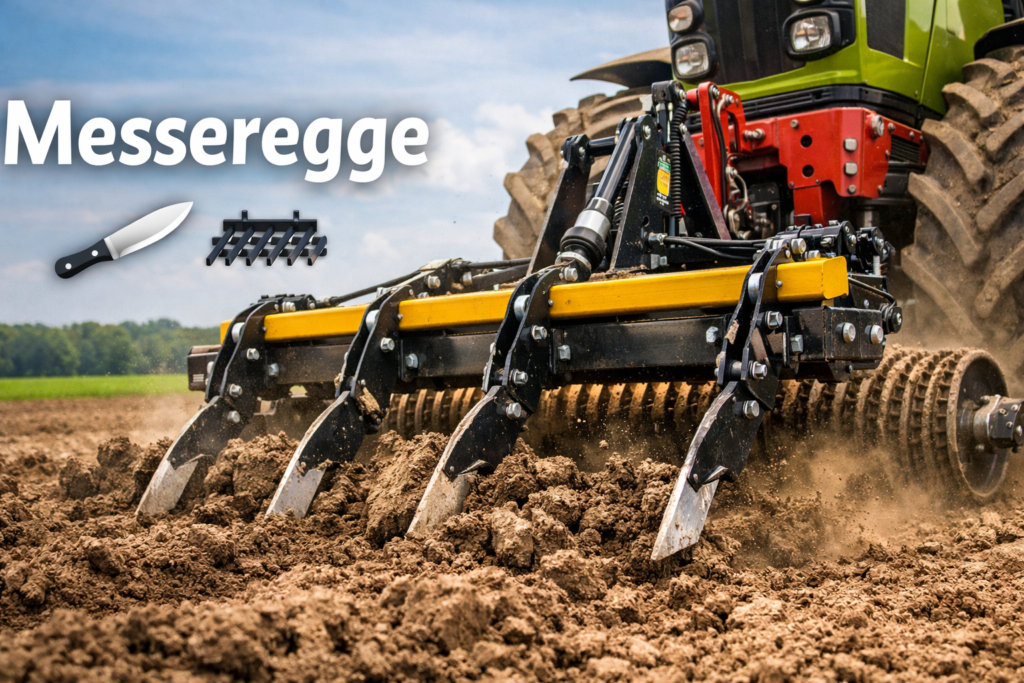
A Messeregge isn’t exactly an everyday English word. And that’s probably why it confuses people at first. Based on the clearest sources, Messeregge is tied to agriculture and soil preparation, not some vague internet concept. In practical use, it refers to a knife-style harrow element or front-mounted attachment used to break clods, level the surface, and help create a more even seedbed before planting.
The word itself makes more sense when you split it up. “Messer” in German means knife, while “Egge” means a harrow, which Duden defines as a farm tool used for shallow loosening, crumbling soil, and weed control. Put together, Messeregge points to a knife-like harrow tool used in field work. Simple enough… but actually pretty useful.
Quick Facts About Messeregge
| Aspect | Details |
|---|---|
| Basic meaning | A German agricultural term combining knife and harrow concepts. |
| Main job | Breaking larger soil clods and improving the seedbed. |
| Typical setup | Often mounted at the front with a frontpacker or similar implement. |
| Adjustment | Working depth can be adjusted by spindle and, in some systems, hydraulically. |
| Construction clues | Parts catalogs show left, right, and straight knives/blades for Messeregge systems. |
How a Messeregge Works
In the farming setup shown by Kerner and Fliegl, a Messeregge works as a front-mounted tool ahead of or alongside a roller system. Its purpose is to crush clods, smooth uneven ground, and prepare the upper soil layer so the seedbed becomes finer and more uniform. That matters because planting into rough, lumpy ground usually gives you less consistent field conditions. Not ideal.
Kerner’s manual also shows that the tool is height-adjustable, and the working depth is set through spindles so the operator can keep the tool level across the width of the machine. That detail sounds technical, sure, but it tells you something important: a Messeregge is not just a fixed bar of steel. It’s meant to be tuned for the soil and the job.
And there’s another practical layer here. Recent Kerner material describes the Messeregge as one of several “pre-tools” or front tools offered with a frontpacker, alongside options like a spring-tine harrow or crossboard. In other words, farmers choose it when they want a certain style of clod breaking and surface preparation. It’s one option in a bigger tillage system, not a random standalone word floating around the internet.
Why Farmers May Use a Messeregge
A Messeregge matters because field preparation is rarely just about turning soil. Farmers often need the surface crumbled, leveled, and firmed correctly for the next step. A frontpacker system with a Messeregge is designed to combine several of those effects in one pass or one working setup.
Here are the practical benefits often associated with a Messeregge:
- Breaks larger clods and soil lumps so the surface becomes easier to work with.
- Helps create a more even seedbed, which is a big deal before sowing.
- Works with adjustable depth settings, so it can be tuned for different field conditions.
- Fits into larger frontpacker systems, where crumbling, leveling, and reconsolidation are combined.
- Uses replaceable blade components in some systems, which hints at real-world wear and serviceability.
What to Check Before Buying or Writing About One
If you’re using Messeregge in content for a website, it helps to be precise. Don’t describe it as a trendy digital concept unless you have a very specific brand context, because the strongest evidence points to agricultural equipment. And if you’re buying or comparing one, look at these points first:
- Working width and compatibility with your machine.
- Depth adjustment options.
- Blade layout and replacement parts availability.
- Soil type, because some systems are optimized differently for heavier or wetter ground.
Final Thought
So, what is Messeregge? Most credibly, it’s an agricultural term for a knife-style harrow attachment used in seedbed preparation. Not flashy. Not mysterious. But useful, and actually pretty interesting once you see where it fits in modern field equipment. Sometimes the odd-looking words are the practical ones.